

Miami Sailing School is highlighting the role of hands on training in developing practical sailing skills and sound decision making. The educational focus follows Captain Russ Beyers recent recognition as a 2025 American Sailing Outstanding Instructor.
Miami, Florida, United States, 10th Oct 2026 – Miami Sailing School is highlighting the role of hands on training in helping sailing students move from learning individual techniques to applying those skills in changing conditions on the water. The educational focus follows the schools recent announcement that Captain Russ Beyer was recognized by American Sailing as a 2025 Outstanding Instructor and examines how practical experience contributes to the development of capable and increasingly independent sailors.
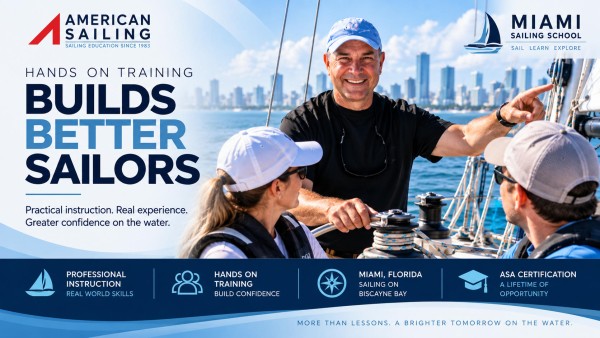
Real World Experience Connects Knowledge With Application
Sailing instruction includes concepts that can be introduced through discussion, diagrams and course materials, but many skills require practical experience before they become familiar. Sail trim, steering, docking, anchoring, navigation and crew communication involve decisions that change according to wind, traffic, vessel movement and surrounding conditions. Hands on training gives students an opportunity to apply those concepts aboard a sailboat while developing a clearer understanding of how individual actions affect the vessel.
Miami Sailing School incorporates practical training throughout its sailing courses so students can experience the relationship between instruction and actual boat handling. Rather than treating individual maneuvers as isolated exercises, training places them within the broader process of preparing, operating and managing a cruising sailboat. This allows students to work through procedures while also learning to observe conditions, communicate with others aboard and anticipate what may happen next.
Sailing Lessons Develop More Than Individual Techniques
Learning to sail requires a combination of technical knowledge, physical skills and judgment. A student may understand how to adjust a sail or execute a maneuver while still needing experience to determine when that action is appropriate. Repetition under different conditions helps students recognize how changes in wind direction, boat speed, traffic and available space can affect the decisions made aboard a vessel.
The schools approach to sailing courses in Miami emphasizes this progression by combining American Sailing certification requirements with practical time on the water. Students develop fundamental sailing skills while also learning how those skills interact during normal vessel operations. As experience increases, students can take greater responsibility for planning maneuvers, communicating with crew and evaluating conditions before taking action.
Decision Making Becomes Part of the Learning Process
Practical instruction also creates opportunities for students to develop decision making skills in situations that cannot always be reproduced through classroom study. Conditions on the water are rarely identical from one lesson to another. Wind strength and direction may change, vessel traffic can increase, weather can develop and docking conditions may vary. Students must learn to observe these factors and determine how they influence the operation of the boat.
This process is an important part of developing situational awareness. Instead of focusing only on the immediate task, students learn to consider the vessel, crew, weather, navigation hazards and surrounding traffic at the same time. As training progresses, instructors can reduce the amount of direct guidance and allow students to assume more responsibility for evaluating conditions and selecting an appropriate response.
Biscayne Bay Provides a Varied Training Environment
Much of Miami Sailing Schools instruction takes place on Biscayne Bay, where students can encounter changing winds, navigation channels, shoals, recreational traffic and a range of docking and anchoring situations. The environment allows sailing concepts to be applied under conditions that require students to remain aware of both vessel performance and their surroundings.
Training in an active marine environment also demonstrates why the same maneuver may require different decisions under different circumstances. A docking approach that works under light wind may need to be adjusted when wind or current changes. Sail selection and trim can vary as conditions develop, while navigation decisions may be influenced by traffic, depth and the intended route. Exposure to these variables helps students understand sailing as an ongoing decision making process rather than a fixed sequence of procedures.
Instruction Progresses Toward Greater Student Responsibility
As students gain experience, practical instruction can gradually shift responsibility from instructor to student. Early training may involve detailed explanations and demonstrations before students perform a maneuver themselves. With repetition, students can begin preparing for maneuvers independently, communicating instructions to others aboard and identifying potential problems before they require corrective action.
This progression reflects the teaching approach of Captain Russ Beyer, who was recognized by American Sailing as a 2025 Outstanding Instructor. Beyers instruction emphasizes practical seamanship, situational awareness and the reasoning behind decisions made aboard a sailboat. The recognition was based on verified student evaluations and provides additional context for the schools continuing focus on student development and applied sailing education.
Hands On Training Supports Sailing Beyond Certification
American Sailing certification establishes defined standards for knowledge and practical skills, but many students continue sailing in environments where an instructor is no longer aboard. Some may pursue additional certifications, charter sailboats, purchase a vessel or continue developing their abilities through recreational and coastal sailing. Practical training helps prepare students for that transition by requiring them to combine individual skills while assuming increasing responsibility for the vessel.
The ability to complete a maneuver remains important, but independent sailing also requires sailors to recognize developing situations, communicate effectively and make decisions before conditions become difficult to manage. Miami Sailing Schools instructional approach places those responsibilities alongside technical training so students can develop a broader understanding of seamanship as their experience increases.
About Miami Sailing School
Miami Sailing School is the flagship service brand of Miami Sailing Company LLC and provides American Sailing certification courses and practical sailing instruction in Miami, Florida. The school focuses primarily on private and small group adult instruction, with training designed to develop sailing skills, seamanship, situational awareness, confidence and sound decision making aboard cruising sailboats. Instruction is led by Captain Russ Beyer, a United States Coast Guard licensed captain and Certified American Sailing Instructor.
Miami Sailing School is led by Captain Russ Beyer, recognized by American Sailing as a 2025 Outstanding Instructor.
Media Contact
Organization: Miami Sailing School
Contact Person: Russ Beyer
Website: https://miamisailing.com/
Email: Send Email
City: miami
State: florida
Country: United States
Release id: 49405
View source version on King Newswire:
Miami Sailing School Explains How Hands On Training Develops Better Sailors
Disclaimer: The views, suggestions, and opinions expressed here are the sole responsibility of the experts. No Atlas Story journalist was involved in the writing and production of this article.